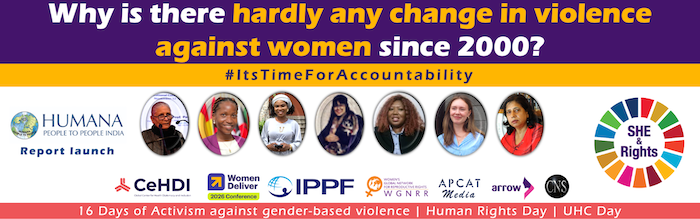
The recent SHE & Rights (Sexual Health with Equity & Rights) session—held during the 16 days of activism against gender-based violence, marking International Human Rights Day on 10 December and Universal Health Coverage (UHC) Day on 12 December—brought together global voices to connect the dots between human rights, universal health coverage, and ending gender-based violence (GBV).

“Violence against women and girls is a violation of human rights, rooted in gender inequality and an impediment to sustainable development,” said Dr Pam Rajput, a noted feminist leader and keynote speaker. She warned that despite decades of advocacy, “we are far behind from the goal of ending all forms of violence against women and girls.”

Over 840 million women have faced violence globally, including 316 million abused by intimate partners in the past year alone. “Even women parliamentarians and journalists are not free from violence,” she added, stressing the need to dismantle structural inequalities and patriarchal norms.
Shobha Shukla, coordinator of SHE & Rights and president of APCAT Media, said “There has been virtually no decline in violence against women and girls since 2000.” Only 104 of 193 countries have comprehensive domestic violence laws, and even where laws exist, “funding to address violence is declining.” She called this reality “alarming and unacceptable.”
The intersection of GBV and HIV was underscored by Esther Asuquo of Nigeria’s AGE Network, who explained that violence “creates a cycle of stigma and discrimination,” increasing women’s vulnerability to HIV. Albertina Nyatsi from Eswatini said integrating GBV services into HIV care is essential to “end AIDS and deliver on gender equality by 2030.”
On another front, Dr Huda Syyed of Australia’s Sahara Sisters’ Collective called attention to the global rise in female genital mutilation (FGM/C), which has affected over 230 million women worldwide. “We cannot meet the SDGs when half the population is harmed, silenced, or excluded,” she asserted.
Alanna France, representing the All-In Initiative, noted that GBV is “entirely preventable” and that proven interventions have reduced violence by up to 50% in some regions.
The event also saw the launch of ESSENCE: 25 Years of HIV & AIDS Initiatives of Humana People to People India, emphasizing how stigma, discrimination, and GBV hinder access to care for women, sex workers, and homeless populations.
Angel Babirye from Uganda concluded with a call to “end period poverty and stigma,” noting that one in four Ugandan girls drops out of school after menstruation begins. “Menstruation is normal,” she said. “Girls must have safe spaces, clean water, and dignity.”
The SHE & Rights session reaffirmed a powerful truth: advancing human rights, universal health coverage, and gender equality are inseparable from ending gender-based violence.