Toppan Holdings, the University of Osaka Graduate School of Engineering, the Japanese Foundation for Cancer Research (JFCR), and Sapporo Medical University have succeeded in engineering a 3D model capable of in vitro replication of the robust barrier (physical barrier) of refractory cancers that impedes attacks by immune cells.
Immunotherapy is becoming a mainstream cancer treatment. The most significant challenge for the treatment, however, is that the robust barrier formed by some refractory solid tumors inhibits the action of immune cells, limiting the therapy’s efficacy. This barrier is an important target for drug discovery, but with conventional technologies it has been difficult to replicate the barrier in vitro for use in drug evaluation.
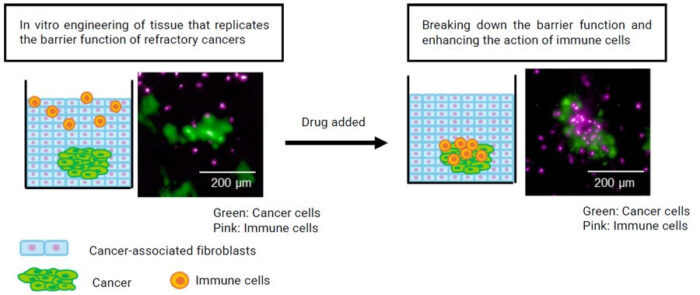
In the reported research, Toppan Holdings’ proprietary 3D cell culture technology, invivoid, was used to engineer a 3D model that replicates the refractory cancer barrier in vitro by controlling the position of cells. Lead searching using the model successfully identified drug candidates that significantly enhance immune cells’ ability to attack cancer cells. This achievement is expected to contribute to innovative drug discovery research on refractory cancers and to businesses supporting drug discovery.
A paper presenting the findings of the research has been published in Acta Biomaterialia, an international scientific journal focusing on the biomaterials field.

Background
Dramatic progress is being made with CAR-T, TCR-T,1 and other cancer immunotherapies, but in the case of some refractory solid tumors, T cells are unable to sufficiently infiltrate the interiors of tumors, meaning that the effectiveness of treatment is limited. One of the factors inhibiting infiltration by T cells is the existence of immunosuppressive tumor microenvironments (TMEs), where cancer-associated fibroblasts (CAFs) secrete large quantities of collagen, forming a physical barrier.

With conventional cell culture methods, it has been difficult to replicate and evaluate these complex spatial structures and the robust barrier functions produced by CAFs. Mice are conventionally used to evaluate immunotherapies but, as distinct species, the immune responses of humans and mice differ, meaning that it is not possible to stably recreate human tumor microenvironments inside the bodies of mice. This has prompted a compelling need for an evaluation model capable of replicating complex human tumor microenvironments and immune responses in vitro.
Overview
The research used invivoid, a proprietary 3D cell culture technology developed by Toppan Holdings and collaborators, to engineer a model for quantitative analysis of T cell infiltration and cytotoxicity.
1) Construction of a structure that accurately replicates in vivo tumor microenvironments
The model mimics the characteristics of human TMEs, featuring layered architecture formed of stromal cells and containing aggregates of cancer cells. It was confirmed that when T cells are introduced, they recognize cancer cells and accumulate around the cells to destroy them.
2) In vitro replication of the immune cell exclusion phenomenon that is characteristic of refractory solid tumors
CAF-rich stromal tissue (barrier) was engineered by activating fibroblasts. This model successfully replicated how refractory solid tumors exclude immune cells, with T cell tissue infiltration and cytotoxicity being significantly inhibited.
3) Identification of drug candidates that break down the robust barrier
The immune cell exclusion model was employed when using approximately 90 drug candidates to search for those with the potential to restore cancer cell cytotoxicity. As a result, it was found that a specific drug class—histone deacetylase (HDAC) inhibitors3—demonstrated synergistic effects in significantly enhancing the cytotoxicity of T cells against cancer cells. This indicates a mechanism for facilitating T cell infiltration into tumors, whereby the drug weakens the ability of CAFs to form a barrier, potentially paving the way for new treatment strategies against refractory solid tumors.
Roles of organizations
・Toppan Holdings: Fabricating and evaluating 3D tissue using proprietary 3D cell culture technology invivoid
・Osaka University: Refining and improving invivoid™ from the perspective of tissue engineering
・JFCR: Planning and conducting drug screening to explore drug candidates that break down the barrier
・Sapporo Medical University: Overall supervision of the research and provision of TCR-T and immune cell specimens
The research paper – Engineering a multilayered 3D stromal barrier model for quantitative analysis of T cell infiltration and cytotoxicity – was published in Acta Biomaterialia on 15 October 2025 by authors Rii Morimura, Isana Nada, Yuka Mizue, Eiji Shinozaki, Naoya Fujita, Ryohei Katayama, Michiya Matsusaki, Yoshihiko Hirohashi, Shiro Kitano, Toshihiko Torigoe
The model established by this research will be of significant use in developing new drugs that facilitate immune cell infiltration into tumor microenvironments and in clarifying the mechanism of interaction between cells.
Based on this technology, the four organizations will accelerate application to innovative drug discovery research and businesses supporting drug discovery.