Ahead of International Yoga Day on 21 June 21, Traya – a personalized hair health platform – has released what is arguably one of the largest lifestyle health snapshots of urban India.

Drawing on self-reported data from 9,42,451 Indians (5,62,088 men and 3,80,363 women) who completed Traya’s diagnostic hair test in March 2026, the analysis maps three lifestyle markers that are foundational to both hair health and overall well-being: sleep quality, stress levels, and digestive health.

The findings paint a picture that should give pause on a day dedicated to holistic wellness. India’s metros are stressed, sleep-deprived, and dealing with digestive discomfort at scale – and the patterns are strikingly consistent regardless of gender.
Each respondent self-reported their sleep patterns, stress levels, and gut health as part of Traya’s diagnostic hair test, which maps root causes of hair loss across genetics, nutrition, stress, sleep, and gut health. The analysis covers the top 30 cities and 15 states by respondent volume.
Sleep: India Is Not Resting Easy
Sleep is the one lifestyle metric where both surveys used substantially similar response options – making direct gender comparison possible. When we restrict the analysis to only those responses that have identical wording in both the male and female questionnaires (and exclude ~31% of female responses that had no male equivalent), a clear and consistent picture emerges.
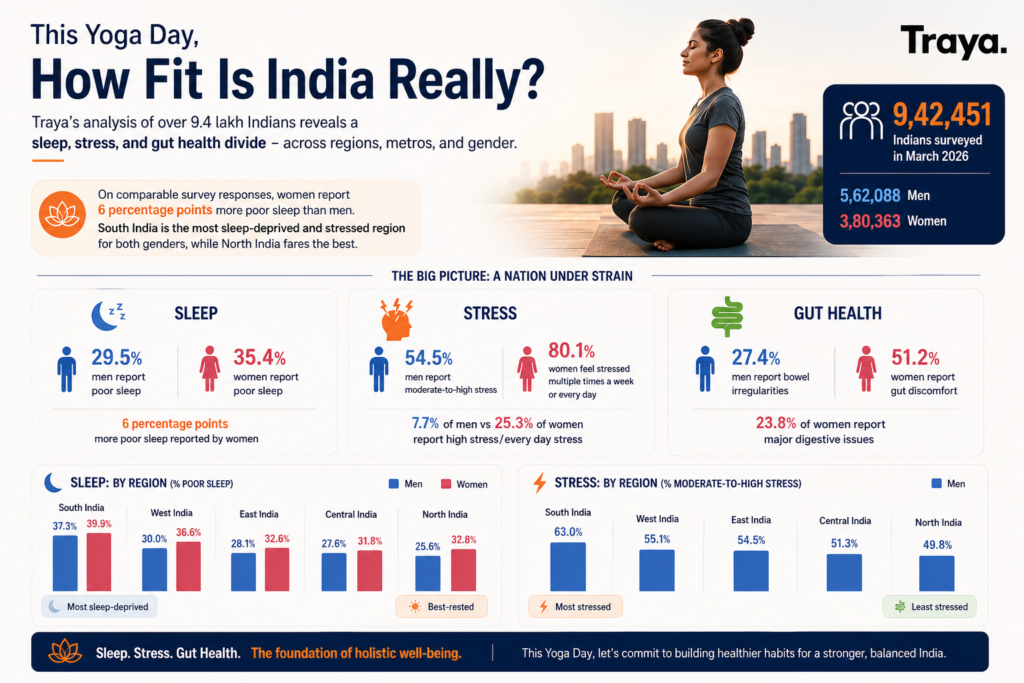
Nationally, on comparable responses, 29.5% of men and 35.4% of women report poor sleep (either disturbed sleep or difficulty falling asleep). The gender gap is real but moderate – roughly 6 percentage points. 22.2% of men report disturbed sleep (waking up at least once during the night), compared to 26.2% of women – a 4 percentage point gap. On difficulty falling asleep, the numbers are even closer: 7.3% of men versus 9.2% of women.
The regional picture: South India sleeps the worst
The geographic pattern is remarkably consistent across genders. South India – comprising Karnataka, Tamil Nadu, Telangana, Andhra Pradesh, and Kerala – reports the highest rates of poor sleep for both men and women. 37.3% of Southern men and 39.9% of Southern women report poor sleep, making the South the only zone where nearly 4 in 10 respondents of either gender struggle with sleep. Interestingly, the gender gap in South India is among the narrowest at just 2.6 percentage points – suggesting that South India’s sleep deficit is more environmental than gendered.
North India (UP, Delhi NCT, Rajasthan, Haryana, Punjab, Uttarakhand, J&K) fares the best among men at 25.6% poor sleep, while Central India performs best for women at 31.8%. West India (Maharashtra, Gujarat) sits in the middle at 30.0% for men and 36.6% for women – with a notable 6.6 percentage point gender gap, the second widest after North India’s 7.2 points.
The metro story: Chennai leads sleep deficit
Chennai stands out as the city where sleep quality is worst for both genders: 42.6% of men and 43.6% of women report poor sleep – and the gender gap is a negligible 1 percentage point. Hyderabad follows at 36.7% (men) and 40.5% (women), and Bengaluru at 33.6% and 38.3%. The pattern is clear: Southern metros are struggling with sleep more than any other part of India.
Among Northern cities, Jaipur fares best with just 23.3% of men reporting poor sleep, while New Delhi shows the widest gender gap of any major metro: 28.0% for men versus 36.5% for women – an 8.5 percentage point difference. Mumbai mirrors this pattern with a 7.7 point gap (32.5% vs 40.2%).
Stress: South India and southern metros lead
The stress data reveals clear and striking geographic patterns – though it must be noted that the male and female surveys used fundamentally different stress scales. Men were asked to rate their stress on a severity scale (High / Moderate / Low), while women were asked about the frequency of feeling stressed (every day / 3–5 times a week / 1–2 times a week / calm and relaxed). Because these scales measure different dimensions, this section reports each gender’s patterns independently rather than comparing them directly.
Men: Over half the country reports moderate-to-high stress
Nationally, 54.5% of men report moderate-to-high stress, with 7.7% reporting high stress (defined as stress triggered by major life events such as loss, separation, or illness). The zone-level variation tells a vivid story:
South India leads at 63.0% moderate-to-high stress (9.0% high), making it the most stressed zone for men by a wide margin. West India (Maharashtra, Gujarat) follows at 55.1%, then East India at 54.5%. North India reports the lowest rates at 49.8% – the only zone where less than half of men report elevated stress – and Central India is close behind at 51.3%.
At the city level, Chennai tops the male stress charts at 65.5% (with 9.9% high stress), followed by Hyderabad at 63.6% and Bengaluru at 61.7%. The three worst cities for male stress are all Southern metros. On the other end, Jaipur (48.1%) and Lucknow (49.1%) are the least stressed major cities for men.
Women: The geographic pattern holds
On the frequency-based scale used in the women’s survey, 25.3% of women nationally report feeling stressed almost every day – and another 54.8% report feeling stressed multiple times a week. Only 19.9% of women describe themselves as calm and relaxed most days.
The regional ranking mirrors the male pattern exactly. South India leads at 81.9% moderate-to-frequent stress, followed by West (79.9%), East (79.6%), North (79.1%), and Central India (78.6%). The zone-to-zone variation for women (3.3 percentage points between worst and best) is much narrower than for men (13.2 points), suggesting that women across India report consistently high stress regardless of geography.
Among cities, Chennai again tops the charts for women at 85.2%, with Kolkata second at 83.5% and Mumbai and New Delhi tied at 82.0%. Patna (75.4%) and Jaipur (76.8%) are the metros where women report the least frequent stress.
Digestive Health: different questions, converging concerns
The gut health data is the least comparable across genders – men were asked a single question about constipation, while women completed a multi-select assessment covering a broad range of symptoms including acidity, bloating, gas, constipation, IBS, and loose motions. These are fundamentally different instruments, so this section reports each gender separately.
Among men, 27.3% report some form of bowel irregularity (including 8.2% who report serious issues such as IBS or unsatisfactory bowel movements). East India and Central India report the highest rates at 29.6% and 29.7% respectively, while South India – surprisingly, given its lead on sleep and stress – has the lowest rate of constipation among men at 24.0%.
Among women, on the broader multi-select gut assessment, 51.2% report at least one digestive concern, with 23.8% reporting major issues (constipation, IBS, loose motions, or serious digestive problems). East India leads at 55.2%, followed by North India at 53.3%. South India again bucks the trend, reporting the lowest rate of gut issues among women at 45.9%.
One pattern worth noting: unlike sleep and stress where South India is worst, for digestive health, South India actually fares best for both genders. This suggests that the region’s dietary habits may offer some protection for gut health even as its respondents struggle more with sleep and stress.
Why this matters on Yoga Day
International Yoga Day was conceived as a reminder that wellness is not an indulgence – it is a necessity. The data from nearly 9.5 lakh Indians makes the case that the necessity has never been more urgent.
The two lifestyle markers where India’s urban population shows the most consistent strain – sleep and stress – are precisely the two where yoga has the strongest evidence base. A growing body of research shows that regular yoga practice improves sleep onset latency, increases total sleep time, and reduces nighttime awakenings. For stress, studies consistently demonstrate that yoga and pranayama reduce cortisol levels, lower self-reported anxiety, and improve emotional regulation.
The geographic consistency of the data – South India leading on both sleep and stress distress for men and women alike, Chennai and Hyderabad consistently at the top of city-level rankings – suggests that lifestyle factors tied to urban intensity, work culture, and possibly climate play a role that transcends gender. Meanwhile, the gender gap on sleep (∼6 percentage points on comparable responses) indicates that women do face an additional sleep burden, though it is more modest than a superficial reading of the raw numbers might suggest.
In summary: Traya’s analysis of over 9.4 lakh Indians – one of the largest lifestyle health snapshots compiled by a consumer health brand – reveals that roughly 3 in 10 men and more than 1 in 3 women report poor sleep on comparable metrics, South India is the most strained region on both sleep and stress for either gender, and Chennai is the metro where the strain is most acute. The geographic patterns are remarkably consistent across men and women – the same zones and cities rank worst regardless of gender. This Yoga Day, the data makes the case for yoga not as a cultural inheritance to be celebrated once a year, but as a daily intervention that India’s urban population may need now more than ever.
Key Numbers at a Glance
Sleep (like-for-like comparison):
• Men: 29.5% report poor sleep | Women: 35.4% report poor sleep (on comparable responses)
• Worst zone: South India (37.3% men, 39.9% women) | Best zone: North India (25.6% men)
• Worst city: Chennai (42.6% men, 43.6% women) | Best major city: Jaipur (23.3% men)
Male stress (severity scale):
• 54.5% of men nationally report moderate-to-high stress (7.7% high)
• Worst zone: South India (63.0%) | Worst city: Chennai (65.5%)
Female stress (frequency scale):
• 25.3% of women report feeling stressed almost every day
• Worst zone: South India (81.9% moderate-to-frequent) | Worst city: Chennai (85.2%)
Male digestive health (constipation):
• 27.3% report bowel irregularities | Worst: East/Central India (~29.7%) | Best: South India (24.0%)
Female digestive health (multi-select gut assessment):
• 51.2% report at least one concern (23.8% major) | Worst: East India (55.2%) | Best: South India (45.9%)